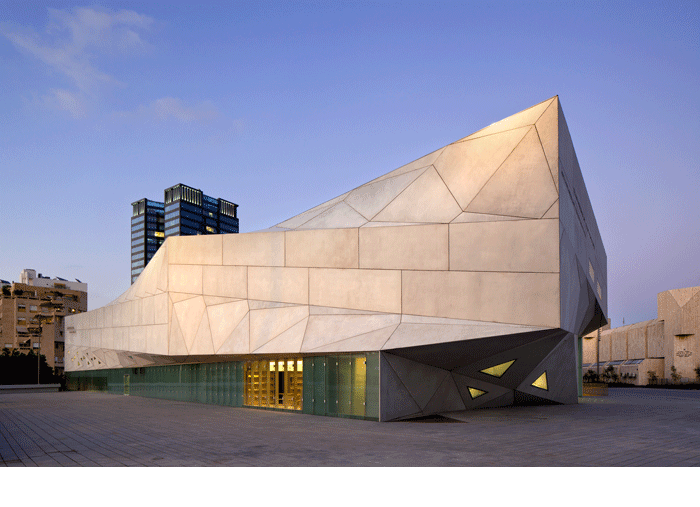
Moshe Sadfie was born in Haifa, Israel and moved to Canada with his
family as a teenager. He attended McGill University and apprenticed with
Louis Kahn (another renown architect with a Jewish background). Safdie catapulted to
fame with his Habitat '67 project, an adaptation of his McGill master's
thesis built for the exposition in Montreal.
During his
illustrious career, Safdie has worked on many projects that are
connected with Jewish culture and history, including the Holocaust
History Museum at Yad Vashem and extensive work renovating the Old City
of Jerusalem. He writes about many of his experiences working on
projects in Jerusalem in his book Jerusalem: The Future of the Past.
Safdie's connections to the GSD also run deep; he served as the Director of the Urban Design Program and subsequently was the
Ian Woodner Professor of Architecture and Urban Design. He also taught a Jerusalem-based studio one semester at the GSD.
Safdie
has seemingly been everywhere in the architectural news a lot recently,
having recently completed the U.S. Institute of Peace in Washington
D.C., the Kauffman Center for the Performing Arts in Kansas City,
Missouri, and the Crystal Bridges Museum of American Art in Bentonville,
Arkansas.
The information of his upcoming talk has been reposted below from the GSD website:
Moshe Safdie, "On Invention and Fitness"
When
Tuesday, February 21
06:30pm
- 08:00pm
add to calendar
Where
Piper Auditorium, Gund Hall, 48 Quincy Street, Cambridge, MA
Event Description
Moshe Safdie is an architect, urban
planner, educator, theorist, and author who embraces acomprehensive and
humane design philosophy. Safdie is committed to architecture
thatsupports and enhances a project’s program; that is informed by the
geographic, social, andcultural elements that define a place; and that
responds to human needs and aspirations. Major projects by Moshe Safdie
currently under construction or recently completed includeMamilla Alrov
Center, a 40-acre development that runs contiguous with the Old City
inJerusalem; Marina Bay Sands, a mixed-use integrated resort in
Singapore; Khalsa HeritageMemorial Complex, the national museum of the
Sikh people in India; the United States Instituteof Peace Headquarters
in Washington, D.C.; the Kauffman Center for the Performing Arts
inKansas City, Missouri; Crystal Bridges Museum of American Art in
Bentonville, Arkansas; andGolden Dream Bay, a residential and retail
complex in Qinhuangdao, China.
Safdie has designed and realized a wide range of projects around the
world, including cultural,civic, and educational institutions; mixed-use
urban centers and airports; and master plans forexisting neighborhoods
and entirely new cities. Many of his buildings have become
belovedregional and national landmarks, including Habitat ’67, Montreal,
Canada; Exploration PlaceScience Center, Wichita, Kansas; Salt Lake
City Public Library, Salt Lake City, Utah; PeabodyEssex Museum, Salem,
Massachusetts; Skirball Cultural Center, Los Angeles, California;
theNational Gallery of Canada; and Yad Vashem Holocaust Museum,
Jerusalem, Israel.In 1978, after teaching at Yale, Safdie relocated his
residence and principle office to Boston, where he also served as the
Director of the Urban Design Program at the Harvard UniversityGraduate
School of design, and subsequently was the Ian Woodner Professor of
Architecture and Urban Design. In addition to numerous articles on the
theory and practice of architecture, Safdie has written several books,
most notably:
Beyond Habitat (1970),
For Everyone a Garden (1974),Form and Purpose (1982),
Jerusalem: The Future of the Past (1989), and
The City After theAutomobile (1997).
Moshe Safdie II,
a second monograph of his work, was published in 2009.Based in Boston
with offices in Toronto, Jerusalem and Singapore, Safdie has been the
recipientof numerous awards, honorary degrees, and civil honors,
including the Companion of the Orderof Canada and the Gold Medal of the
Royal Architectural Institute of Canada.
Firm website.
Photo: Crystal Bridges Museum of American Art
Bentonville, Arkansas, US. © Timothy Hursley